


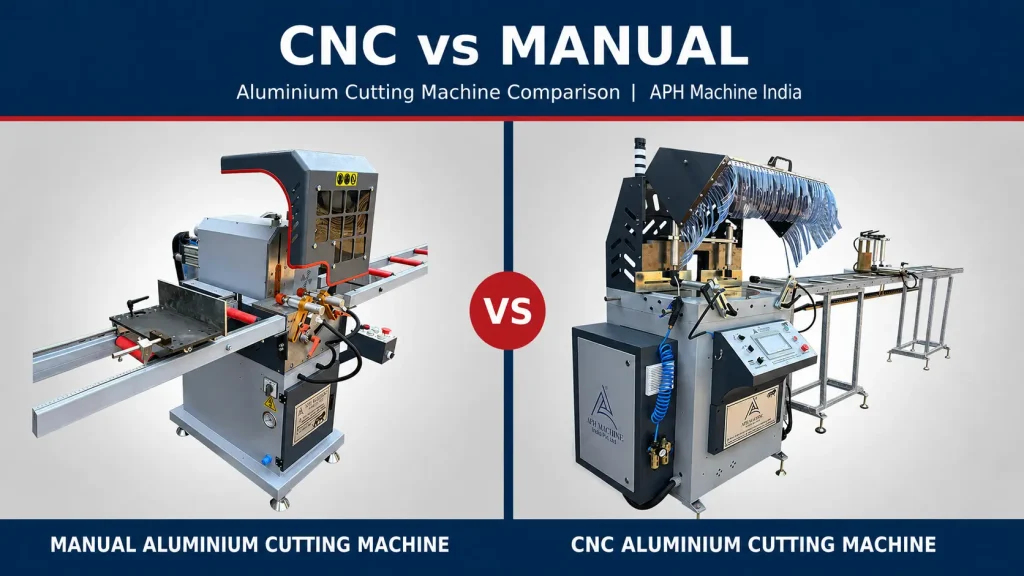
When you’re setting up or upgrading an aluminium profile cutting line, one of the biggest decisions isn’t just which machine, it’s how automated it should be. Should you go with a manual or standard automatic cutting machine, or invest in a CNC-controlled one? The answer affects your labor cost, your accuracy across large production runs, and how well your machine can adapt as your order volume grows.
This guide breaks down the real difference, so you’re choosing based on your production reality, not just which option sounds more advanced.
The Core Difference
A manual or standard automatic cutting machine relies on the operator to set the cutting angle, position the profile, and trigger each cut. Even in “automatic” variants, the operator still manages measurement and positioning for each new job.
A CNC (Computer Numerical Control) cutting machine reads a programmed cutting sequence, then positions, clamps, and cuts the profile automatically to the exact length and angle specified — repeating that same accuracy whether it’s the 1st piece or the 1,000th.
The difference isn’t really “manual vs automatic” in the old sense. It’s operator-dependent accuracy vs programmed accuracy.
What is a Manual / Standard Automatic Cutting Machine?
A manual or standard automatic cutting machine is a machine where the operator directly controls the key cutting parameters, such as angle, position, and when the cut is triggered, rather than a computer program handling them automatically. “Automatic” in this category usually refers to the cutting or clamping action itself being powered (pneumatic or motorized), not to the machine deciding measurements on its own. The operator still reads the required specification, sets the machine accordingly, and confirms each job.
This is the category our Variable Angle Single Head Cutting Machine falls into: a digital display shows the cutting angle (adjustable from 30° to 150°), but the operator sets and confirms it for each job.
Typical specifications:
- Power supply: 380V, 50Hz
- Input power: 3 KW
- Weight: approximately 650kg
- Cutting angle: 30°–150° (digital display, manually set)
Strengths:
- Lower upfront cost
- Simple to operate and maintain
- Flexible across varied, non-standard cutting jobs
- No programming knowledge required from the operator
Trade-offs:
- Accuracy depends on operator skill and consistency
- Slower changeover between different job specifications
- Harder to scale labor efficiently as volume increases
What is a CNC Cutting Machine?
A CNC cutting machine is a machine where the cutting sequence, including angle, length, and clamping, is controlled by a computer program rather than by the operator adjusting settings manually for each piece. The operator loads the profile and starts the program; the machine handles positioning and cutting to the exact specification every time, without needing to be re-measured or re-set between pieces.
Our CNC Double Head Cutting Machine and CNC Single Head Cutting Machine add touchscreen automation and programmable control to the same core cutting mechanics.
Typical specifications (CNC Double Head Cutting Machine):
- Input power: 6 KW / 7.1 KW
- Cutting length tolerance: ±0.005mm
- Cutting angles: 90°, 45° (automated positioning)
- Motor rotation speed: 2800 r/min
Strengths:
- Consistent accuracy across large production runs, not dependent on operator fatigue or skill variation
- Faster changeover between different cutting specifications, since the program (not the operator) resets the settings
- One operator can typically manage what would otherwise need two or three people across separate manual setups
- Reduces material waste from inconsistent cuts
Trade-offs:
- Higher upfront investment
- Requires basic operator training on the control panel/programming interface
- Less practical if your work is highly varied and low-volume, since programming overhead isn’t worth it for one-off jobs
Side-by-Side Comparison
| Factor | Manual / Standard Automatic | CNC-Controlled |
|---|---|---|
| Accuracy consistency | Depends on operator | Fixed by program, repeatable |
| Cutting tolerance | Operator-dependent | As tight as ±0.005mm (double head CNC) |
| Speed on repeat jobs | Moderate | High — no re-measuring between pieces |
| Speed on one-off/varied jobs | Good — no programming needed | Slower to set up for a single custom piece |
| Labor requirement | Higher (skilled operator per machine) | Lower (one operator can run more output) |
| Upfront cost | Lower | Higher |
| Best fit | Small workshops, varied job-shop work | Medium-to-high volume, standardized production |
How to Decide: A Volume-Based Framework
Rather than deciding based on which sounds more modern, decide based on your actual daily cutting volume and how repetitive your job specifications are:
Choose manual/standard automatic if:
- You cut fewer than roughly 100–150 pieces per day
- Your jobs vary significantly in size, angle, or profile type from order to order
- You’re prioritizing lower upfront investment over labor efficiency right now
Choose CNC if:
- You’re running consistent, higher-volume production of similar cuts
- Labor cost per piece matters to your margins — CNC lets one operator do the work that would otherwise need multiple manual stations
- You need to guarantee tight tolerances across a large batch, not just on individual pieces
- You expect to scale volume in the near future and want to build in that capacity now rather than upgrading again later
A practical rule of thumb from the fabrication industry: CNC machines don’t just cut faster, they remove the accuracy variation that comes from a tired or less experienced operator. That consistency is often where the real return on investment shows up, not just in raw cutting speed.
Before You Buy: See It Cut Your Own Profile
Whichever direction you’re leaning, don’t decide purely from a spec sheet. Ask to see the machine cut the actual profile sizes and angles you work with, not just a demo piece. Cutting behavior can vary with wall thickness, alloy grade, and profile shape, and a short demonstration on your own material tells you more than any brochure number.
Talk to APH Machine India
APH Machine India manufactures both manual/standard automatic and CNC-controlled cutting machines, in single head and double head configurations, built in-house at our ISO 9001:2015 certified facility in Vadodara, Gujarat. If you’re weighing this decision for your own production line, share your typical daily volume and job variation with our team, and we’ll help you figure out which one actually pays off for your situation.
Frequently Asked Questions
Is a CNC cutting machine worth it for a small workshop?
Usually not immediately. The higher upfront cost and programming overhead make more sense once your daily volume and repeat-job consistency justify the labor savings. Most small workshops are better served starting with a manual or standard automatic machine and upgrading once volume grows.
Does CNC control improve accuracy, or just speed?
Both, but accuracy is the bigger long-term benefit. A CNC machine repeats the same programmed cut regardless of how many pieces you’ve already run that day, which reduces the small measurement drift that happens naturally with manual operation over a long shift.
Can I upgrade a manual machine to CNC later, or do I need to buy new?
This depends on the machine platform. In most cases, CNC control is built into the machine at the time of manufacture rather than retrofitted, so it’s worth planning for your expected volume 2–3 years out, not just your current output, when making this decision.
How much labor can a CNC cutting machine actually save?
It varies by setup, but a single CNC-controlled machine can often reduce the operator headcount needed for a given output compared to running multiple manual stations, since one trained operator can manage programming, loading, and monitoring across a full production run.
Do CNC machines need special maintenance compared to manual machines?
CNC machines have additional electronic and control components, so maintenance includes both the mechanical cutting system and the control panel/software. Regular servicing and keeping the control system’s firmware updated matters more than with purely mechanical manual machines.