


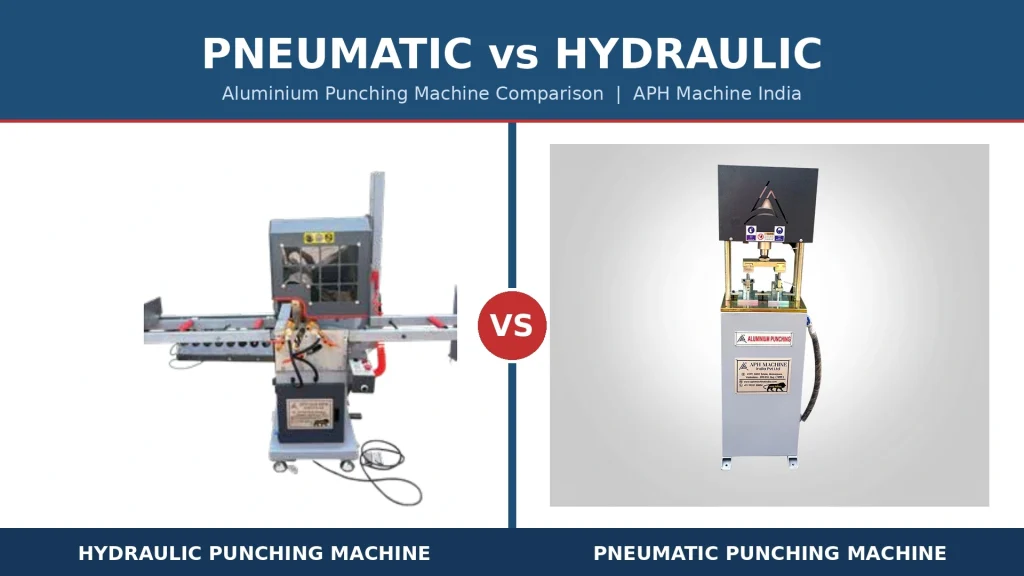
Alongside aluminium cutting machines, punching machines are essential to any fabrication workflow — used to create holes, slots, and hardware openings, such as lock holes, hinge points, and drainage slots, in aluminium profiles used for windows, doors, and curtain walls. But not all punching machines apply force the same way, and that difference matters more than most buyers realize, especially when it comes to thicker or thermally broken profiles.
This guide breaks down the real difference between pneumatic and hydraulic punching machines, including a factor that doesn’t get discussed enough: the risk of damaging the profile itself.
The Core Difference
Both machine types do the same basic job, driving a punch through a profile to create a precise opening, but they generate that force differently.
A pneumatic punching machine uses compressed air to drive the punch. It’s a simpler system, mechanically, and tends to deliver force in a quick, sharp burst.
A hydraulic punching machine uses pressurized hydraulic fluid to drive the punch. This produces a smoother, more continuous application of force, and can generate significantly higher punching pressure than a pneumatic system of a similar size.
What is a Pneumatic Punching Machine?
A pneumatic punching machine is a machine that uses compressed air, rather than fluid pressure, to power the punch through the material. Air is compressed and released through a cylinder to drive the punching action, which is mechanically simpler than a hydraulic system and typically allows for faster cycle times on lighter punching tasks.
Our Aluminium Section Punching Machine is a pneumatic system available in single die, double die, and four die configurations, designed for punching standard aluminium window and door profiles.
Typically better suited for:
- Standard-thickness aluminium profiles
- Higher-speed, repetitive punching cycles
- Lower upfront and running cost
- Simpler maintenance requirements
What is a Hydraulic Punching Machine?
A hydraulic punching machine is a machine that uses pressurized hydraulic fluid, rather than compressed air, to drive the punch. Because hydraulic fluid is far less compressible than air, the system can deliver much higher force, and deliver it more smoothly and consistently through the full punching stroke, rather than as a quick burst.
This matters more than it might sound. A sudden, sharp impact, like a pneumatic punch delivers, can crush or dent the hollow internal chambers of thicker aluminium profiles, particularly thermal-break profiles used in energy-efficient windows and curtain wall systems. A hydraulic system’s smoother force delivery reduces this risk, which is why hydraulic punching is generally preferred for thicker or structurally sensitive profiles.
Typically better suited for:
- Thick or thermal-break aluminium profiles
- Curtain wall and structural glazing applications
- Higher force requirements per punch
- Applications where profile deformation is a real risk with sudden impact force
Side-by-Side Comparison
| Factor | Pneumatic Punching Machine | Hydraulic Punching Machine |
|---|---|---|
| Power source | Compressed air | Pressurized hydraulic fluid |
| Force delivery | Quick, sharp burst | Smooth, continuous |
| Maximum force output | Lower | Higher |
| Cycle speed | Faster on light tasks | Generally slower per cycle, but handles harder tasks in one pass |
| Risk to thick/thermal-break profiles | Higher (sudden impact can crush hollow chambers) | Lower (smooth force reduces deformation risk) |
| Upfront cost | Lower | Higher |
| Maintenance complexity | Simpler | More complex (fluid system, seals, pump) |
| Best fit | Standard profiles, high-speed repetitive punching | Thick profiles, curtain wall, structural applications |
How to Decide
Choose a pneumatic punching machine if:
- You’re primarily punching standard window and door profiles, not thick or thermal-break sections
- Cycle speed and cost-efficiency matter more than maximum force
- You want simpler, lower-maintenance equipment
Choose a hydraulic punching machine if:
- You regularly work with thick, thermal-break, or curtain wall profiles
- Profile deformation or crushing has been a problem with your current punching setup
- You need higher force for heavier-duty punching applications
A practical middle-ground question to ask yourself: has sudden-impact punching ever caused visible denting, crushing, or hairline stress marks on your profiles? If so, that’s usually the clearest sign a hydraulic system is worth the higher investment.
Talk to APH Machine India
APH Machine India manufactures pneumatic aluminium section punching machines in-house, available in single die, double die, and four die configurations, built at our ISO 9001:2015 certified facility in Vadodara, Gujarat. If your production involves thicker or thermal-break profiles and you’re evaluating hydraulic punching options (such as our 6 Head Hydraulic Punching Machine), get in touch with our team — we can walk you through what’s available and help you match the right punching force to your actual profile types.
Frequently Asked Questions
Can a pneumatic punching machine damage aluminium profiles?
It can, particularly on thicker or thermal-break profiles, where the sudden burst of force from a pneumatic system may crush or dent the hollow internal chambers. This risk is lower with standard, thinner profiles.
Is a hydraulic punching machine always the safer choice?
Not necessarily “safer” in general, but it does reduce the risk of profile deformation on thicker or structurally sensitive sections. For standard profiles, a well-maintained pneumatic system is usually sufficient and more cost-effective.
Which is cheaper to run, pneumatic or hydraulic?
Pneumatic systems are generally cheaper both to purchase and maintain, since they have fewer moving parts and no hydraulic fluid system to service. Hydraulic systems cost more upfront and require fluid and seal maintenance, but can handle heavier-duty work in return.
Do curtain wall fabricators typically need hydraulic punching machines?
Often yes, particularly for structural or thermal-break sections where profile integrity matters more and sudden-impact punching carries a higher deformation risk.
Can one machine handle both light and heavy punching tasks?
Some hydraulic systems are powerful enough to handle both, but a pneumatic machine generally cannot substitute for a hydraulic one on thick or high-force applications. Many fabricators running mixed profile types keep both types of machines rather than relying on one for everything.