


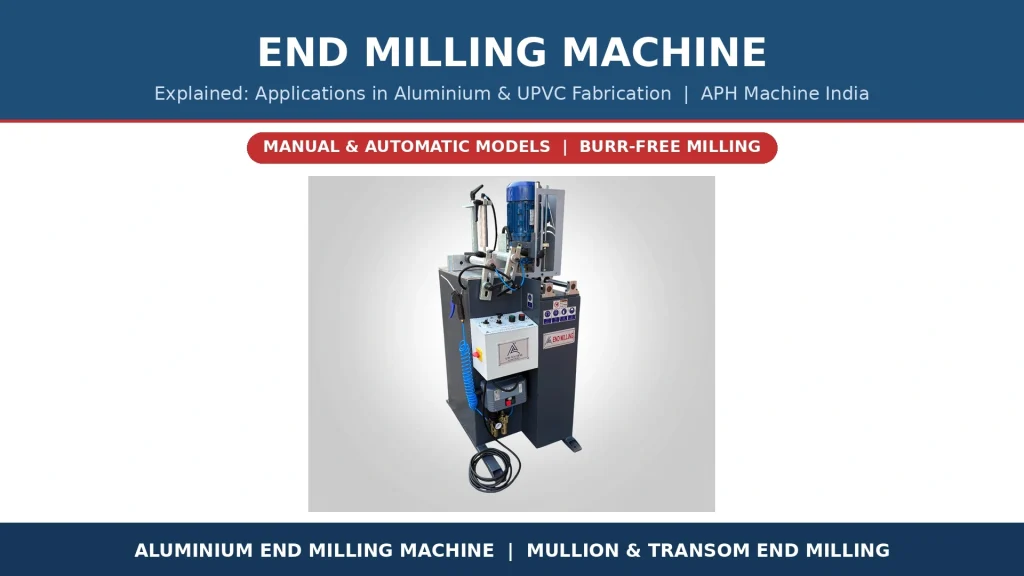
In window, door and curtain wall fabrication, cutting a profile to length (using an aluminium cutting machine) is only the first step. When one profile has to meet another at a right angle, its end often needs to be shaped so that it sits tightly against the profile it joins. The machine that does this shaping is called an end milling machine, and the quality of its work shows up directly in how well the finished frame fits, seals and holds together.
This guide explains what an end milling machine is, how it works, where it is used in aluminium and UPVC fabrication, and what to look for when choosing one.
Quick Answer
An end milling machine mills the end of a profile, usually a mullion or transom, into the exact shape needed to join it neatly against another profile. It is used after cutting and before assembly. A manual model suits lower volumes and a simpler setup, while an automatic model with pneumatic clamping and feeding suits steady production.
What is an End Milling Machine?
An end milling machine is a machine that uses a rotating milling cutter to shape the end face of a profile, cutting the notches, steps and grooves that let it fit precisely against a frame or another profile. Instead of a plain flat cut, the profile end is machined to match the profile it will meet, so the joint closes up tight.
In aluminium and UPVC window fabrication, it is most often used for the ends of mullions and transoms, the vertical and horizontal bars that divide a window or door frame into sections. The machine clamps the profile, then a cutter, or a set of cutters, mills the end to shape in a single pass.
What Are Mullions and Transoms?
A mullion is a vertical bar that divides a window or door frame, and a transom is a horizontal one. They connect into the outer frame or into each other, so their ends cannot be a simple straight cut. The end has to be milled to the contour of the profile it meets, which is exactly the job of an end milling machine.
Why Does End Milling Quality Matter?
The fit of every mullion and transom against its frame depends on the quality and repeatability of the end milling. When the milling is accurate, the joint sits flush and the frame assembles squarely. When it isn’t, you can run into:
- Visible gaps at the joint — spoiling the aesthetic appearance of the finished window or door
- Weak or misaligned connections — compromising the structural stability of the assembly
- Poor sealing — which can let air, dust, and water leak through the frame
- Extra rework and hand finishing — causing expensive bottlenecks and slowdowns during assembly
Because the same cut is repeated across many pieces, a consistent machine matters more than a single good result.
How Does an End Milling Machine Work?
The process is simple in outline:
- The profile is positioned and clamped: Clamps hold it firmly so it cannot shift or deform during milling.
- The cutter is set for the profile: The milling cutter, or a stack of cutters, is selected and adjusted to match the shape of the profile being machined.
- The cutter feeds into the end of the profile: In an automatic machine, a pneumatic cylinder drives the cutting action. In a manual machine, the operator controls it.
- The profile end is milled to shape: It emerges cleanly contoured, ready to be assembled against its mating profile.
Cutter size and adjustment determine which profiles a machine can handle, and some machines can mill several profiles in one operation to raise productivity.
What Are the Applications in Aluminium and UPVC Fabrication?
End milling machines are used wherever one profile must join another accurately:
- Aluminium window and door frames: milling mullion and transom ends so they connect flush to the outer frame
- Curtain wall and facade systems: shaping larger structural profile ends that demand a precise architectural fit
- Notches and step faces: cutting the stepped contours and notches that specialized interlocking joints require
- UPVC window and door fabrication: end milling is also widely used on UPVC mullions and transoms, typically with a specialized cutter set matched to the UPVC profile system
Some machines also offer angled milling for arched or special-shape windows, usually as an option.
What is the Difference Between Manual and Automatic End Milling Machines?
A manual end milling machine relies on the operator to control the feed of the cutter into the profile, while an automatic machine uses a pneumatic cylinder to drive the cutting action, giving a more consistent feed and less operator effort across a long run. Both use clamping to hold the profile in place.
| Factor | Manual End Milling Machine | Automatic End Milling Machine |
|---|---|---|
| Cutter feed | Operator controlled | Pneumatic cylinder driven |
| Consistency across a long run | Depends on the operator | More uniform |
| Operator effort | Higher | Lower |
| Footprint (W x L x H) | 700 x 600 x 1500 mm (Smaller) | 1150 x 600 x 1500 mm (Larger) |
| Best fit | Lower volume, simpler setup | Steady, higher-volume production |
What Does APH Machine India's Aluminium End Milling Machine Offer?
APH Machine India’s Aluminium End Milling Machine is used for milling the mullion profile so that it connects securely to the frame profile, and it can mill multiple profiles at one time for higher productivity. It is available in both manual and automatic models.
Key specifications:
- Motor: 2.2 kW (3 HP), 3-phase, 415V/220V, 2800 r/min
- Main shaft diameter: 32 mm
- Maximum milling cutter diameter: 180 mm
- Workable travelling: 310 mm
- Working air pressure: 5 to 7 Kgf/cm², with SPAC pneumatic cylinders
- Clamping: Horizontal and vertical pneumatic clamping to prevent profile distortion
- Cutting operation: Pneumatic cylinder for automatic cutting operation (automatic model)
- Lubrication: Italian lubricant technology pneumatic spray valve for burr-free milling
- Build: 12 mm HE30 grade aluminium base plate and durable aluminium casting structure
- Guides & Panel: Hard chrome rod guide movement and an electro-pneumatic panel
- Adjustability: Cutter adjustable up and down, left and right to suit different profiles
- Cutter customization: End mill cutter made as per your specific profile requirement
- Overall size (H x W x L): H1500 x W1150 x L600 mm (automatic), H1500 x W700 x L600 mm (manual)
For UPVC profiles or a special cutter requirement, speak to our engineering team about the right machine configuration.
What Should You Check When Choosing an End Milling Machine?
Work through these key factors before committing to a purchase:
- Profile range: Will the cutter diameter (up to 180 mm) and workable travelling stroke (310 mm) cover the profiles you actually run?
- Cutter set: Can cutters be made to order to match your profile system, and how easily can they be changed or adjusted?
- Clamping system: Firm, even dual horizontal and vertical clamping prevents profile deformation and keeps the milled end true.
- Feed type: Choose manual for lower batch runs or automatic with pneumatic cylinder drive for continuous daily production.
- Finish quality: Ensure spray lubrication or cooling is included (such as our Italian pneumatic spray valve) to maintain burr-free cuts and extend tool life.
- Air and power supply: Confirm your shop compressor delivers 5 to 7 Kgf/cm² and that 3-phase power is available.
- Your own profile test: Always ask to see the machine mill your actual profile, not only a generic sample piece.
If you are also comparing suppliers as well as machines, our guide on how to choose the right aluminium fabrication machinery supplier covers what to check beyond the machine itself.
Talk to APH Machine India
APH Machine India manufactures its Aluminium End Milling Machine in both manual and automatic versions in-house at our ISO 9001:2015 certified facility in Vadodara, Gujarat. Tell us your profile types and daily volume and we’ll recommend the model and custom cutter setup that fits your workflow.
Frequently Asked Questions
What is the difference between an end milling machine and a copy router?
An end milling machine shapes the end face of a profile so it joins another profile squarely (such as mullions and transoms), while a copy router machine cuts holes and slots (such as lock slots and hardware openings) along the profile body using a template. Many window fabrication workshops use both machines side by side. For a breakdown of router options, see our guide on mini vs pneumatic vs heavy duty copy router machines.
Where does end milling fit in the fabrication process?
End milling takes place after the profile is cut to length and before frame assembly. A typical workflow begins with precision profile cutting (e.g. on a double head cutting machine), followed by end milling and punching or copy routing, and finally corner crimping and assembly.
Can one machine mill several profile types?
Yes, within the range of its cutter diameter and travel stroke. Cutters can be adjusted up/down and left/right, or changed to suit different profiles, though completely different profile systems may require their own custom cutter stack.
Do I need an automatic end milling machine?
Not necessarily. A manual machine is often sufficient for lower volume workshops or smaller custom jobs. Automatic models make more sense when you run steady production and want a uniform, pneumatic-controlled feed that minimizes operator fatigue.
Can an end milling machine be used on UPVC profiles?
End milling is common in UPVC window fabrication as well, using a specialized cutter set matched to the UPVC profile geometry. If you work with UPVC, contact our engineering team so we can evaluate your profile drawings and configure the correct machine and cutter package.
Does the machine need a compressor?
Yes. The pneumatic clamping system on both models and the automatic cutter feed on the automatic model operate on compressed air at 5 to 7 Kgf/cm², requiring a workshop compressor of suitable capacity.