


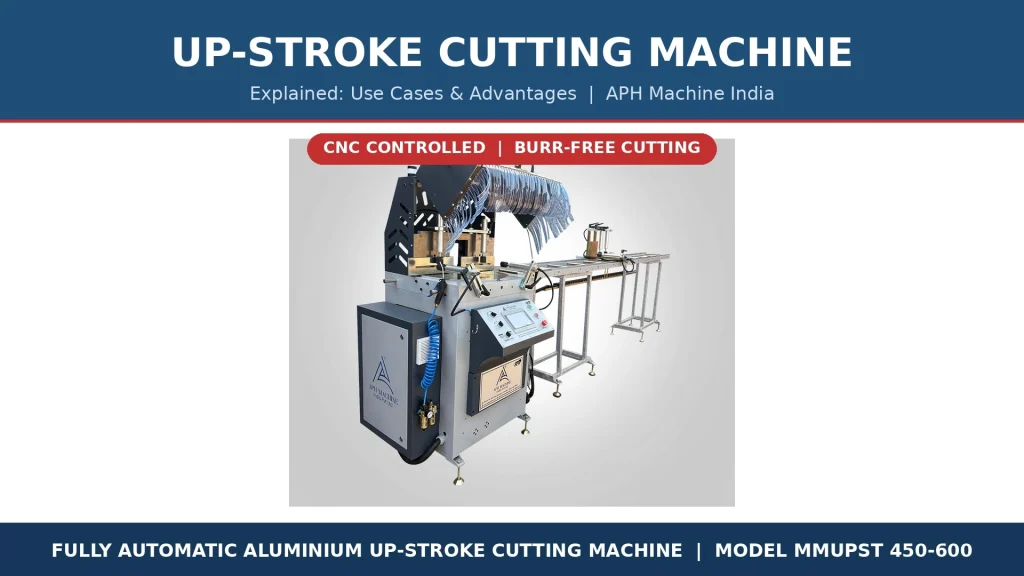
If you’ve come across the term “UP-Stroke Cutting Machine” while researching aluminium profile cutting equipment, it’s a reasonable question to ask what actually makes it different from a standard cutting machine. The name refers to a specific detail in how the blade moves, and that detail has real consequences for cut quality, speed, and safety.
This guide explains what an UP-Stroke cutting machine actually is, how it works, and when it’s the right choice for your production line.
What is an UP-Stroke Cutting Machine?
An UP-Stroke cutting machine is a cutting machine where the saw blade rises upward through the material from below, rather than being pulled or pushed downward through it from above, as most standard aluminium cutting machines do. The blade sits below the cutting bed at rest and travels upward into the profile to complete the cut.
This upward cutting motion changes a few key aspects of how the machine performs:
- Cleaner, burr-free cuts: Because the blade enters the material from underneath in a controlled upward path, it tends to produce a smoother edge with less burring on the cut face compared to a blade forced downward through the material under gravity and feed pressure combined.
- Better chip and swarf clearance: Cutting debris is naturally directed downward, away from the cut line and the operator’s working area, rather than building up on top of the workpiece.
- A safer resting position: The blade retracts below the cutting bed when not in use, rather than sitting exposed above the workpiece, which reduces accidental contact risk during loading and unloading.
In short, the “UP-Stroke” name isn’t just a branding term, it describes the actual cutting direction, and that direction is largely responsible for the clean, consistent finish these machines are known for.
Our UP-Stroke Cutting Machine
APH Machine India’s Fully Automatic Aluminium UP-Stroke Cutting Machine (Model MMUPST 450/500/550/600) is built around this upward-cutting mechanism, combined with automatic height adjustment and Siemens CNC control.
Key specifications:
- Automatic cutting height adjustment
- Servo stepper motor with ball screw cutting operation
- CNC control panel with 5″ and 7″ HMI display, Siemens controller
- Pneumatic clamp and de-clamp operation
- Italian lubricant technology pneumatic spray valve for burr-free cutting
- Cutting angle: 45°, 90°, and any angle in between, automatically
- Cutting width: 225mm to 450mm
- Cutting height: 125mm to 250mm
- Saw blade: Freud (made in Italy), sizes 450/500/550/600mm
- Power supply: 2.2 KW, 3 HP, 415V/220V
Use Cases
UP-Stroke cutting machines are commonly used for:
- Aluminium window and door frame cutting: Clean edges matter directly for how well frame joints fit and seal.
- Curtain wall profile cutting: Larger structural sections where finish quality and dimensional accuracy both matter.
- Any-degree profile cutting: Jobs that need angles beyond standard 90°/45°, without resetting the machine manually for each job.
- Applications where burr-free finish reduces secondary processing: A cleaner cut straight off the saw means less time spent deburring before assembly.
Advantages Over Standard Cutting Machines
When evaluated against conventional downward-stroke equipment like a standard single head cutting machine or double head cutting machine, the upward cutting motion introduces notable mechanical advantages:
| Factor | UP-Stroke Cutting Machine | Standard Downward-Feed Cutting Machine |
|---|---|---|
| Cut finish | Typically cleaner, less burring | More prone to burring, especially at higher feed speeds |
| Chip/swarf clearance | Directed downward, away from work area | Can accumulate on top of the workpiece |
| Blade resting position | Retracted below the cutting bed | Often exposed above or at the workpiece level |
| Angle flexibility | Any-degree cutting in CNC-controlled models (45° to 90°) | Typically fixed to standard angles unless variable-angle model |
| Best fit | Frame profiles, curtain wall, angle-flexible jobs | High-volume standardized 90°/45° production |
Talk to APH Machine India
APH Machine India manufactures the Fully Automatic Aluminium UP-Stroke Cutting Machine in-house at our ISO 9001:2015 certified facility in Vadodara, Gujarat, featuring a Siemens CNC control panel and an Italian Freud saw blade for consistent, burr-free cutting. If you’re weighing this against a standard or variable-angle cutting machine for your production line, share your typical profile sizes and angle requirements with our team, and we’ll help you figure out the right fit.
Frequently Asked Questions
Does "UP-Stroke" just mean the machine cuts faster?
Not primarily. The term refers to the direction the blade moves through the material, upward rather than downward, which is what produces the cleaner cut and better chip clearance. Speed is a secondary benefit that comes from reduced need for rework, not from the stroke direction itself.
Is an UP-Stroke cutting machine only useful for aluminium?
No, the upward cutting principle applies to various materials, but it’s particularly valued in aluminium profile cutting because burring and chip buildup are common quality issues with standard downward-feed cutting on softer metals.
Do UP-Stroke machines require different blades than standard cutting machines?
The blade itself is similar in type, typically a carbide-tipped circular saw blade, but the machine’s mechanism and clamping system are built specifically around the upward stroke motion, so blades and machines are usually matched by the manufacturer rather than interchangeable across machine types.
Can an UP-Stroke cutting machine handle any-degree cutting, or only standard angles?
CNC-controlled UP-Stroke machines, including APH Machine India’s MMUPST series, support any-degree cutting between 45° and 90°, with automatic positioning rather than manual angle resetting for each job.
Is the burr-free finish from an UP-Stroke machine good enough to skip a separate deburring step?
In many cases yes, particularly for window and door frame applications, though this depends on your specific tolerance and finish requirements. It’s worth testing on your own profile material before assuming you can eliminate a deburring step entirely.